Zero-Knowledge Rollups (ZK-Rollups): The Fastest Way to Scale Blockchain in 2026
 May, 26 2026
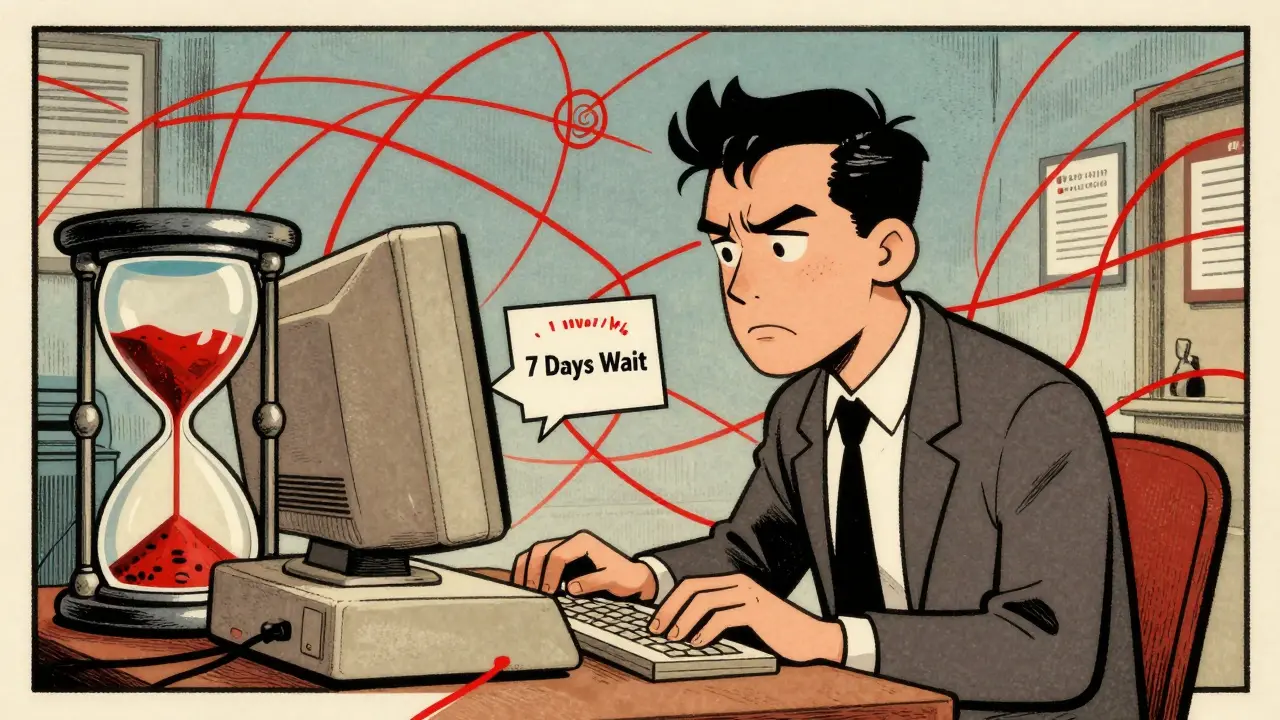
Imagine trying to send money across the world and having to wait seven days just to be sure it actually arrived. That was the reality for many users on early Layer 2 solutions like Optimistic Rollups. Now, in 2026, that frustration is largely behind us thanks to a technology that feels almost magical: ZK-Rollups is a Layer 2 scaling solution that uses cryptographic proofs to process transactions off-chain while settling them securely on-chain. If you are tired of high gas fees and slow withdrawals, this is the technology changing the game.
But what exactly makes ZK-Rollups different from everything else? Why are developers and institutions betting big on them right now? Let's break down how they work, why they are faster, and what you need to know before using them.
How ZK-Rollups Actually Work
To understand ZK-Rollups, you first need to understand the problem they solve. Blockchains like Ethereum is the primary Layer 1 network that provides security and settlement for most rollups are secure but slow. They can only handle about 15-30 transactions per second. When everyone tries to use them at once, fees skyrocket.
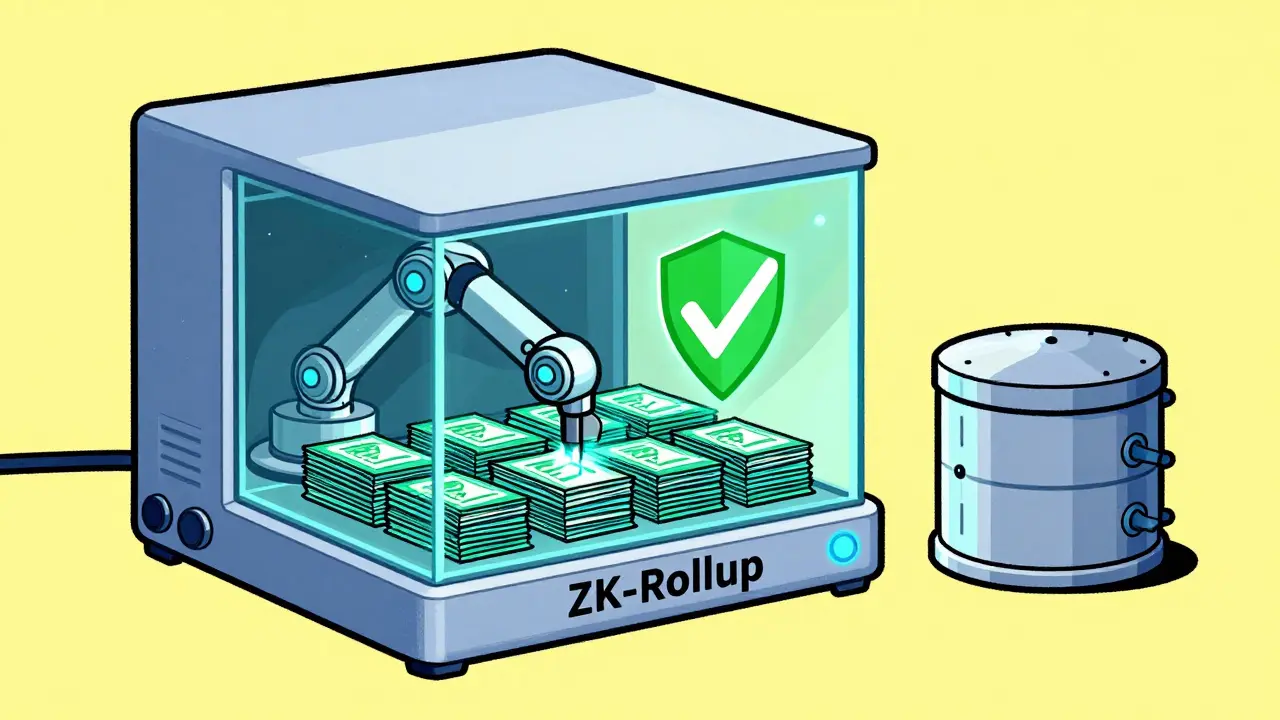
ZK-Rollups solves this by moving the heavy lifting off the main blockchain. Here is the step-by-step process:
- You submit a transaction: You interact with a dApp (decentralized application) built on the ZK-Rollup. This happens off-chain, so it’s fast and cheap.
- Batching: A system called a Sequencer is an operator that collects individual transactions and bundles them into batches for efficiency collects hundreds or thousands of these transactions and groups them together.
- Proof Generation: This is the magic part. The sequencer generates a mathematical proof showing that all those transactions were valid. No one needs to re-check every single detail; the proof guarantees correctness.
- On-Chain Settlement: The batch data and the proof are sent to Ethereum. The network checks the proof (which takes milliseconds) and updates its state.
The key here is that Ethereum doesn't have to execute every transaction. It only has to verify the proof. This saves massive amounts of computational power and space.
SNARKs vs. STARKs: The Two Types of Proofs
Not all ZK-Rollups are created equal. They rely on two main types of cryptographic proofs: SNARKs (Succinct Non-Interactive Arguments of Knowledge) and STARKs (Succinct Transparent Arguments of Knowledge). Knowing the difference matters if you care about privacy and long-term security.
| Feature | SNARKs | STARKs |
|---|---|---|
| Proof Size | Very small (efficient for on-chain storage) | Larger (more expensive to store on-chain) |
| Verification Speed | Fast | Slightly slower but still efficient |
| Trust Assumptions | Requires a trusted setup ceremony | No trusted setup needed (transparent) |
| Quantum Resistance | Vulnerable to future quantum computers | Quantum-resistant |
| Popular Examples | zkSync, StarkNet (initially) | StarkNet, Aztec |
If you see a project using SNARKs, they likely prioritized smaller proof sizes for cheaper gas fees on Ethereum. If they use STARKs, they are probably focused on transparency and future-proofing against quantum computing threats. Most major projects today are optimizing both approaches.
ZK-Rollups vs. Optimistic Rollups: The Finality Factor
This is the biggest debate in Layer 2 scaling. You’ve probably heard of Arbitrum and Optimism, which are Optimistic Rollups that assume transactions are valid unless challenged. So why switch to ZK?
The answer is finality.
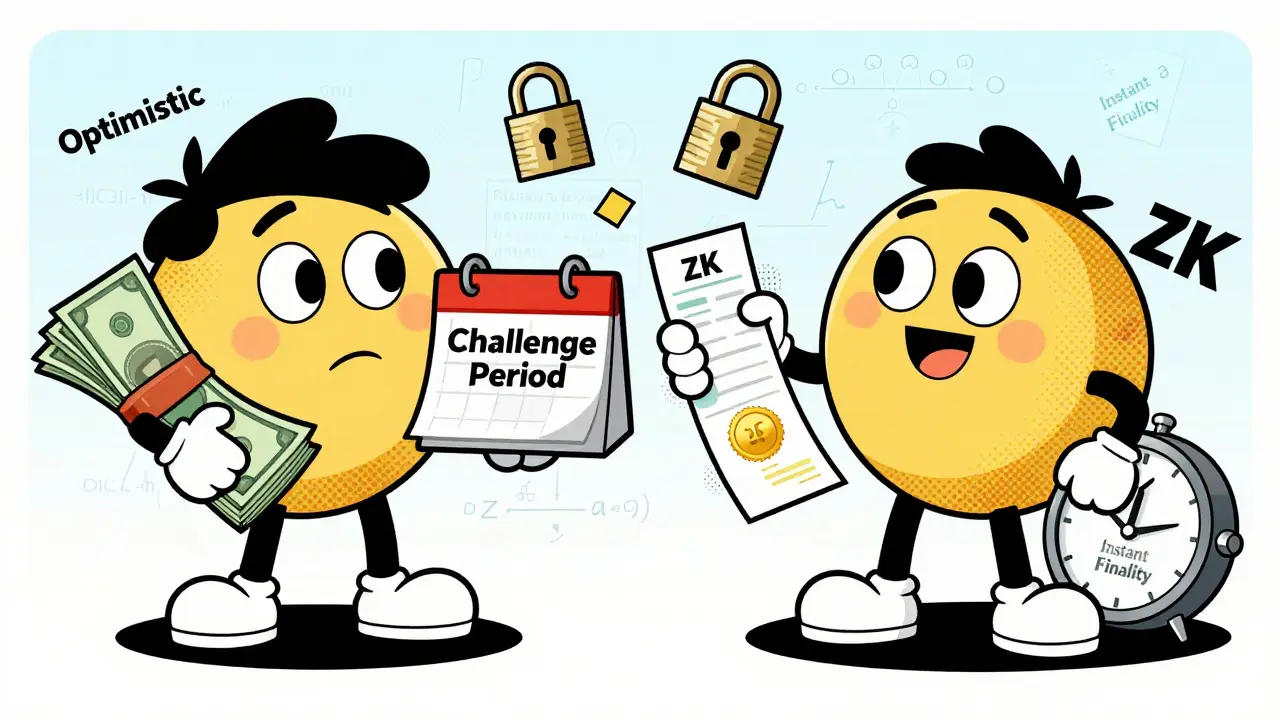
In an Optimistic Rollup, when you withdraw funds, you have to wait up to seven days. This is a "challenge period" where anyone can step in and say, "Hey, that transaction was fraudulent!" If no one challenges it, your money arrives. It works, but waiting a week is annoying.
ZK-Rollups eliminate this wait entirely. Because the validity is proven mathematically before the transaction hits Ethereum, there is no challenge period. Your funds are available immediately after the proof is verified. In 2026, instant finality isn't just a nice-to-have; it's expected. For DeFi traders or gamers who need real-time responses, that seven-day delay is unacceptable.
Think of it this way: Optimistic Rollups are like sending a package via regular mail-it usually arrives fine, but if something goes wrong, you have to file a claim and wait weeks for a resolution. ZK-Rollups are like handing over cash with a receipt that proves the exchange happened instantly. No disputes, no waiting.
Security: Math vs. Economics
Security is often misunderstood. People think Optimistic Rollups are less secure because they have a challenge period. But technically, both are very secure. The difference is *how* they achieve that security.
Optimistic Rollups rely on economic incentives. Validators lock up money as collateral. If they cheat, they lose their stake. It’s a system based on human behavior and financial penalties.
ZK-Rollups rely on mathematical certainty. The cryptography ensures that it is computationally impossible to create a false proof without being detected. There is no "cheating" because the math won't allow it. This reduces the attack surface significantly. You don't have to trust that validators are honest; you just have to trust the mathematics.
For institutional investors and large-scale applications, this mathematical guarantee is often preferred. It removes the risk of human error or collusion among validators.
Who Are the Major Players in 2026?
The ZK-Rollup landscape has matured significantly since 2021. Today, several projects dominate the space, each with slight variations in focus.
- zkSync Era: One of the earliest adopters of zkEVM (Zero-Knowledge Ethereum Virtual Machine). This allows developers to write standard Solidity code and deploy it directly to zkSync with minimal changes. It’s highly developer-friendly.
- StarkNet: Built on STARKs, making it quantum-resistant. It uses a new programming language called Cairo, which requires developers to learn new tools but offers greater flexibility for complex computations.
- Polygon zkEVM: Polygon’s entry into the ZK space, focusing heavily on compatibility with existing Ethereum infrastructure. It aims to bridge the gap between traditional web2 apps and blockchain seamlessly.
- Scroll: Another strong contender focusing on native EVM equivalence, meaning it behaves almost exactly like Ethereum, just faster and cheaper.
Choosing between them often comes down to whether you value ease of migration (zkSync, Scroll) or advanced cryptographic features (StarkNet).
Challenges and Limitations
ZK-Rollups aren't perfect. There are still hurdles to overcome, especially for everyday users.
High Computational Cost for Proofs: Generating the zero-knowledge proof requires significant computing power. While verifying the proof is cheap, creating it is expensive. Projects are constantly working on hardware accelerators and better algorithms to reduce this cost.
Data Availability: Currently, most ZK-Rollups post their transaction data to Ethereum for safety. This means they still pay Ethereum gas fees for data storage. If Ethereum gets congested, ZK-Rollup costs can rise too. Some projects are experimenting with decentralized data availability layers to mitigate this.
Complexity for Developers: While zkEVM helps, building truly optimized ZK applications still requires understanding cryptography. Debugging smart contracts that involve proofs is harder than debugging standard Solidity code.
When Should You Use a ZK-Rollup?
If you are a user, you should prefer ZK-Rollups when:
- You need to move funds quickly without waiting days for withdrawals.
- You are interacting with high-value assets where mathematical security is paramount.
- You want lower transaction fees compared to Ethereum mainnet.
If you are a developer, consider ZK-Rollups if:
- Your application requires frequent, small transactions (like gaming or social media).
- You need cross-chain interoperability (ZK-proofs make bridging between chains easier and more secure).
- You want to build privacy-preserving features (since ZK-tech inherently hides transaction details while proving validity).
The Future of ZK-Rollups
We are just scratching the surface. As hardware improves and algorithms become more efficient, proof generation times will drop further. We might see "recursive proofs," where multiple proofs are combined into one, reducing costs even more.
Additionally, ZK-Rollups are paving the way for private transactions on public blockchains. Imagine sending ETH without revealing the amount or the recipient, yet still maintaining full auditability for regulators. This is possible with ZK-tech and could unlock mainstream adoption for sensitive industries like healthcare and finance.
In 2026, ZK-Rollups are no longer experimental. They are the backbone of scalable, secure, and user-friendly blockchain infrastructure. Whether you are trading tokens, playing games, or building the next big dApp, understanding ZK-Rollups is essential.
What is the main advantage of ZK-Rollups over Optimistic Rollups?
The main advantage is instant finality. ZK-Rollups provide mathematical proof of validity immediately, allowing users to withdraw funds to Layer 1 without waiting for a 7-day challenge period required by Optimistic Rollups.
Are ZK-Rollups safer than Ethereum mainnet?
ZK-Rollups inherit the security of Ethereum mainnet for settlement. While they are not "safer" than Ethereum itself, they offer stronger guarantees against fraud within the Layer 2 environment due to cryptographic proofs rather than economic incentives.
Do I need special hardware to use a ZK-Rollup?
No. Users interact with ZK-Rollups through standard wallets like MetaMask. The heavy computational work is done by operators (sequencers), not end-users.
What is the difference between SNARKs and STARKs?
SNARKs have smaller proof sizes and faster verification but require a trusted setup. STARKs have larger proofs but do not require a trusted setup and are resistant to quantum computing attacks.
Can ZK-Rollups enable private transactions?
Yes. Since zero-knowledge proofs verify validity without revealing underlying data, ZK-Rollups can hide transaction amounts and addresses while still ensuring the network remains consistent and secure.